Introduction
A pneumatic system collects trim, matrix and other production waste from many machines and moves it by air to one or more collection points, often outside the primary production area. Done right, it lets machines run at full speed, keeps the floor clean and quiet, and turns waste into a compact stream. Done wrong, it becomes a bottleneck, with blockages, dust, noise and no room to grow.
What a system done right gives you
- No line jams: When capture, cutting and conveying are designed for the maximum machine speed and the actual material, waste leaves the machine continuously. Trim does not wrap around rollers, matrix does not break and pull back into the press, and pipes and separators do not block, so the line keeps running.
- Low maintenance: A system matched to the material being handled, equipped with the right Granulator and filter, treated surfaces where adhesive is present, and a correctly designed pipe system, stays clean and stable. Maintenance becomes a planned routine, such as knife sharpening and filter care, rather than unplanned stops to clear blockages.
Most of the decisions that decide performance are made before any equipment is chosen. This checklist covers the questions we work through with our customers at the planning stage. Use it to write your internal requirements or as a checklist to compare different solutions.
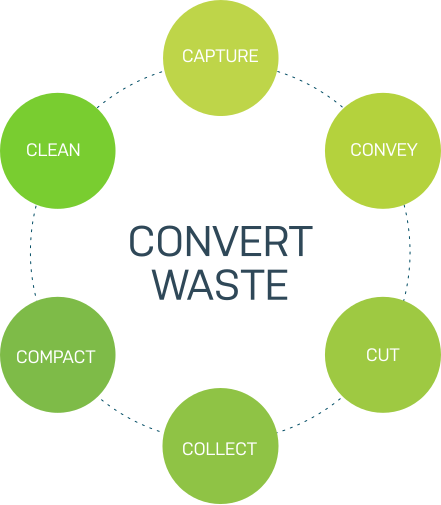
How a Central System works
- Capture: A pick-up nozzle, funnel or hood at each machine draws trim, matrix or waste into the pipe.
- Size reduction: A Granulator (cutter/chopper) cuts the waste into small pieces so it conveys and compacts well.
- Conveying: A purpose made transport fan moves the waste through the pipe network.
- Separation: A separator divides the waste from the conveying air.
- Filtration: Filters remove fine dust before the air is exhausted or returned to the hall.
- Collection: Waste goes to a compactor, baler, press container or bags, ready for disposal, reuse or recycling.
- Controls: Electrical controls, often with frequency converters tie the system to production.
- Central System or All-in-one Unit? Both use the same building blocks. An All-in-one Unit packs the back end into one compact unit next to one or more machines. A Central System typically serves many machines from a shared back end. The checklist below applies to both; the scale of the answers differs.
The planning checklist
1. Map your production today, and in five years
- Every waste source: List each machine, where it stands and how many pick-up points it has (left, right and center trim, matrix, sheet waste, die-cuts, punch-outs, etc.).
- Maximum machine speed: Design for the fastest the web will ever run, not the typical speed. The capture system has to keep up with the line.
- Future plans: New lines, faster machines, relocations. Reserve capacity and spare connection points cost far less now than as a rebuild later.
2. Know your waste material
- Material type: Paper, board, film, foil, nonwovens, laminates, self-adhesive label stock, textiles or copper/aluminum foil. Each behaves differently in the air stream.
- Thickness and stiffness: Very thin films and fine nonwovens need Granulators that cut cleanly; thick, stiff material may need a straight path into the granulator, sometimes one Granulator per pick-up point.
- Adhesive: Exposed adhesive (label matrix, tape) needs non-stick treated pipes, fan and transitions, and Granulators designed for adhesive. Adhesive enclosed between layers is easier, unless the material delaminates easily.
- Dust: Paper, board, nonwovens and other materials can create fine dust, which drives filter choice and maintenance.
- Static: Many plastics charge easily, so grounding and ionisation must be part of the design.
- Combustible or conductive dust: Fine organic dust, metal foils and battery materials may call for explosion protection (ATEX /NFPA) measures in the filter system.
- Separate streams: If materials must be recycled separately, plan for separate collection points and diverter valves connected to the Granulator.
3. Define the waste geometry and volume
- Trim width: Record the actual widths and the widest you might ever run. Ask whether the widest is need-to-have or nice-to-have; designing for more than you need adds capacity, size and cost across the whole system.
- Matrix: Web width, the shape of the matrix (a simple ladder or maybe jobs with a lot of material left), how much of the web becomes waste. These answers set Granulator width and funnel design.
- Quantity: Consider the total amount of waste generated. This helps decide the collection method – you do not want to build a system that requires frequent manual changes of containers or bags.
4. Plan the route: layout and pipe network
- Distance and route: Measure the furthest distance from a machine to the waste collection area and if possible prepare a simple sketch with the machines placed on. The total distance is important for the selection of the right fan.
- Pipe quality: Use pipes intended for material conveying, and treated surfaces where adhesive is present.
- Central equipment location: Inside, in an annex or outdoors. Outdoor placement frees floor space and moves noise and waste traffic out of production but needs outdoor-rated components.
5. Decide how waste is collected and how it leaves the site
- Collection method: Bags or endless tube bags for small volumes; compactor, big-bags, baler or press container for larger ones.
- Ask your recycler: Which format they accept (bales, compacted container, loose granulate), how streams must be sorted, and what they pay or charge depending on the type of material. Maybe separating waste can reduce cost compared to mixed waste streams.
Quick checklist: What suppliers are likely to ask for
| Area | Information to gather |
| Machines | List of machines, pick-up points per machine, maximum speeds, running hours |
| Material | Type, thickness, adhesive (exposed or enclosed), dust and static behaviour |
| Waste geometry | Trim widths (actual and maximum), matrix width and shape, full-web situations |
| Volume | Waste per hour or per week, per machine and in total |
| Layout | Factory drawing with machine positions and desired area for collection of waste |
| Collection | Preferred format |
| Air | Return air or exhaust |
| Integration | Control signals from machines, alarm and data requirements |
| Growth | Planned new lines or speed increases in the next five years |
| Service | In-house maintenance capacity, uptime requirements, need for backup |
Frequently asked questions
What is a pneumatic waste handling system? It is a system that captures trim, matrix, die-cut and other production waste at one or more machines, cuts it, and conveys it by air through a pipe network to a separator, filter and collection point, such as a compactor, bag, baler or press container.
When does a Central System make more sense than machine-side units? A Central System usually pays off when many machines produce waste, floor space near the machines is scarce, you have a large waste amount and want to move the waste away from the primary production area.
Can one system handle both trim and self-adhesive matrix? Yes, if it is designed for it. Exposed adhesive needs non-stick treated components and suitable Granulators, and matrix needs compaction. If streams must be recycled separately, the system needs separate collection points or diverters.
How far can waste be conveyed? It depends on pipe size, air volume, the route and the number of bends and components. Long runs are possible when the fan and pipe network are sized for them, which is why an accurate layout matters early.
How do we keep energy use down? First of all avoid fans on each machine, use a central fan. Use frequency-controlled fans, shut off idle branches automatically, cut waste close to the source, choose filters that stay clean, and return filtered air to the hall where rules allow.
Can the system grow with our production? Yes, if reserve capacity and connection points are planned from the start. Adding capacity to a system that was sized tightly is usually far more complicated.
What does a supplier need to quote a system? A machine list with speeds and pick-up points, material details, waste widths and volumes, a layout drawing, and your requirements for air quality, noise, safety and collection. The quick checklist above covers it.
How Lundberg Tech can help
Lundberg Tech designs and manufactures pneumatic trim, matrix and waste handling systems, from compact All-in-one Units next to a single machine to Central Systems that connect a whole production floor. Our systems handle anything from high-speed edge trim to wide, sticky self-adhesive matrix in label converting, packaging, printing, film and extrusion, nonwovens, laminating and battery converting.
Our sales and project departments support every step: Reviewing your production data, layout and system design, installation, commissioning, training and service.
Planning a new factory, a line expansion or a replacement system? Send us your machine list and a layout drawing, and our team will help you turn the checklist into a system that fits your production.
Partners
Did you know Lundberg Tech is locally represented in 50+ countries? Explore our partner network: Partners